How agencies can monitor client visibility in ChatGPT at scale
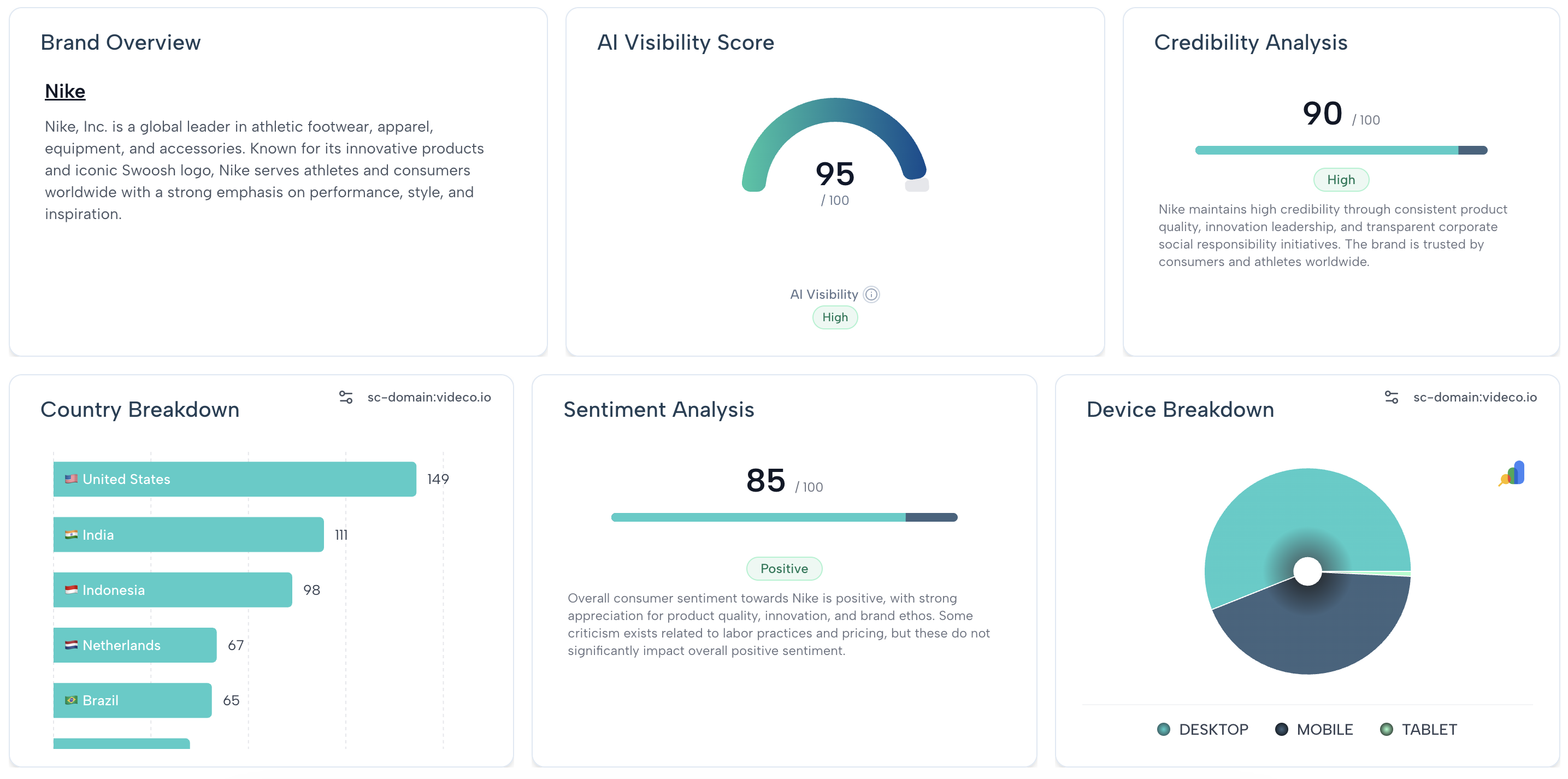
ChatGPT is quietly becoming one of the most influential discovery layers on the internet. People are no longer just searching on Google, they are asking AI tools for recommendations, comparisons, and product suggestions.
For agencies, this creates a new problem. You can no longer measure visibility only through clicks, impressions, and rankings. A brand can be completely invisible in traditional SEO tools but still be frequently recommended or ignored inside ChatGPT.
The question is no longer “How do we rank on Google?” but “How often does ChatGPT mention our clients, and in what context?”
This is where AI visibility tracking becomes critical, especially at agency scale.
Why ChatGPT visibility matters for agencies
When users ask ChatGPT questions like:
- Best marketing dashboards for startups
- Tools like Google Analytics alternatives
- CRM software for agencies
The model often responds with ranked suggestions or curated lists. If your client is missing from those answers, they are effectively invisible in a growing discovery channel.
Unlike search engines, ChatGPT does not show rankings or backlinks. It generates answers dynamically. That means visibility is:
- Inconsistent
- Context dependent
- Hard to measure manually
- Different per prompt and model version
For agencies managing multiple clients, this becomes impossible to track without automation.
The challenge: ChatGPT does not have a ranking system
Traditional SEO tools rely on predictable structures:
- Position 1 to 10 rankings
- Keyword tracking
- Click-through rates
- Indexed pages
ChatGPT does not work like that. There is no fixed SERP.
Instead, visibility depends on:
- Prompt phrasing
- Model training data
- Contextual associations
- Brand authority signals in the model
This means your client might appear in one response but disappear in another.
Without systematic tracking, you are guessing.
What “ChatGPT visibility tracking” actually means
At its core, ChatGPT visibility tracking is about answering four questions:
- Does the model mention your brand?
- In what context is it mentioned?
- How often does it appear across different prompts?
- How does it compare to competitors?
To do this properly, you need to simulate real user behavior at scale.
That means running structured prompts such as:
- Best tools for marketing dashboards
- Top analytics platforms for startups
- Alternatives to [competitor brand]
- Recommended SaaS reporting tools
Then recording whether your client appears in the response.
The scaling problem agencies face
Doing this manually is not realistic.
Even a small agency might manage:
- 10 to 50 clients
- 20 to 100 relevant prompts per client
- Multiple variations per prompt
- Ongoing tracking over time
That quickly becomes thousands of AI queries per month.
And that is just ChatGPT. If you add Claude and Perplexity, the complexity multiplies.
Agencies need:
- Automation
- Structured reporting
- Multi-client management
- Historical tracking
- Unified dashboards
How ZapDigits solves ChatGPT visibility tracking
ZapDigits is built specifically for this new layer of SEO.
Instead of treating ChatGPT as a black box, ZapDigits turns it into a measurable data source.
Here is how it works.
1. Create AI visibility dashboards per client
Each client gets a dedicated dashboard where you define:
- Brand name
- Competitors
- Target prompts or categories
ZapDigits then runs structured visibility checks across ChatGPT responses.
2. Track mentions across real prompts
For each prompt, ZapDigits records:
- Whether the brand is mentioned
- Position in the response (if applicable)
- Context of mention
- Competing brands included
This creates a consistent visibility score over time.
3. Monitor changes over time
ChatGPT responses are not static. They change as models update and as context shifts.
ZapDigits tracks:
- Weekly visibility trends
- Drops or spikes in mentions
- Competitor movement
- Prompt-level performance changes
This gives agencies something SEO never had before: AI ranking history.
4. Compare multiple clients at scale
For agencies, the real power is comparison.
With ZapDigits you can:
- Compare client visibility in the same category
- Benchmark against competitors
- Identify which clients are gaining or losing AI presence
- Prioritize SEO efforts based on AI exposure gaps
5. Combine AI visibility with marketing data
ChatGPT visibility alone is powerful, but it becomes even more useful when combined with:
- Google Search Console
- Analytics data
- Conversion metrics
- Traffic trends
This lets agencies answer a new question:
“Are we growing in search, and are we being recommended by AI at the same time?”
What agencies can actually do with this data
Once ChatGPT visibility becomes measurable, agencies can:
- Optimize content for AI discoverability
- Identify missing keyword or topic coverage
- Adjust positioning based on AI recommendations
- Track competitor dominance in AI answers
- Prove marketing impact beyond traditional SEO
This becomes a new reporting category entirely: AI SEO.
Why this is just the beginning
ChatGPT is only one model in a much larger shift.
People are already asking AI systems instead of search engines. As this behavior grows, “being recommended by AI” will become as important as ranking on Google.
Agencies that start tracking this early will have a significant advantage.
Not because AI replaces SEO, but because it adds a new layer on top of it.
Final thoughts
ChatGPT visibility is not a vanity metric. It is an early signal of how AI systems interpret and recommend brands.
The challenge is not understanding its importance. The challenge is measuring it at scale.
That is exactly what tools like ZapDigits are built for.