
10 Reputation Management Tools Compared for 2026
"Which reputation management tool is best?" is the question buyers bring to a demo, and it's the wrong one. Nothing in a feature list tells you whether a platform survives contact with fourteen dental practices, three franchise brands and a client who wants a PDF every Monday morning. The question that decides the purchase is narrower: which tool fits your business model, your location count and the report your client opens?
The market splits along a line most roundups blur. One group collects, monitors and helps you answer reviews: EmbedMyReviews, BrightLocal, Grade.us, GatherUp, NiceJob, Birdeye, Podium, ReviewTrackers, Yext and Reputation. The other monitors conversations that never reach a review site, and Brand24 is the one worth buying in that category.
That distinction matters because reviews now sit at the front of the research process. A 2024 Prodege survey of 2,000 U.S. consumers found that 54% trusted online reviews before other information sources, well ahead of the 24% who prioritized friends and family, as Reputation's summary of the Prodege findings reports. Whoever controls how those reviews get answered controls a large share of the buying decision.
Each entry below covers what the tool does, where it falls short, how long implementation takes and who should skip it.
Table of Contents
- 1. EmbedMyReviews
- 2. BrightLocal
- 3. Grade.us
- 4. GatherUp
- 5. NiceJob
- 6. Birdeye
- 7. Podium
- 8. ReviewTrackers
- 9. Yext Reviews
- 10. Reputation
- 11. Brand24
- Reputation Management Tools at a Glance
- Choosing and Implementing Your Reputation Stack
1. EmbedMyReviews
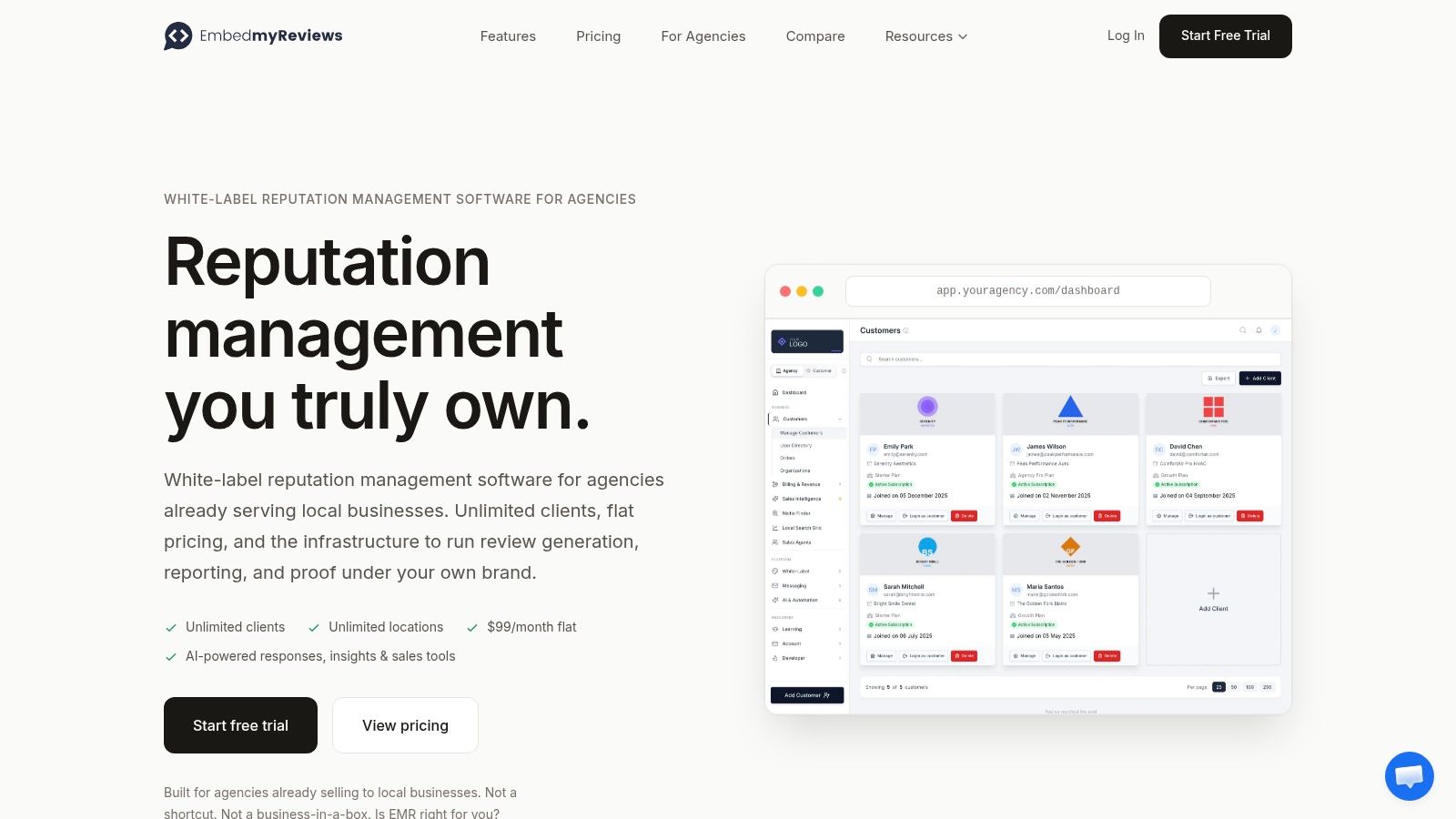
Most review platforms hand an agency a login and a monthly bill. EmbedMyReviews hands over the platform itself: custom domain and SSL, branded UI, branded help center and API docs, and a client experience with no attribution back to the vendor.
Here is what a client sees on your subdomain.
What it replaces in an agency stack
The scope runs wider than review collection. Reviews are pulled from 67+ sources, request campaigns go out through your own email, SMS and WhatsApp keys, multi-step feedback funnels route private complaints away from public pages, and QR or NFC codes track where requests originated.
The second layer is delivery work:
- Google Business Profile publishing: update, offer and event posts with client approval by email, no login required, plus location geotags.
- Local Search Grid: geo-distributed rank tracking with recurring scans and white-label PDF exports.
- Sales intelligence: automated audit reports, a Trust Score and competitor benchmarks you can put in front of a prospect before they sign.
- Reporting and billing: scheduled multi-location dashboards, role-based permissions, custom client plans, credit limits and Stripe billing.
The pricing math agencies miss
The base platform is a flat $99 per month for unlimited clients, locations and users. That structure only looks cheap or expensive next to the alternative, which is analyst time. In a BrightLocal survey of 255 marketers, small businesses and enterprise employees, the average local marketer spent 17% of working time on online reputation management, and 76% planned to spend more time on it the following year, according to BrightLocal's online reputation management survey. Per-location pricing scales with your client list. Analyst hours scale with the same list, faster.
Where it asks work of you
You own the plumbing. Domain and SSL, provider keys for messaging and AI models, prompt templates for review responses, approval rules and the funnel logic all sit with you. Budget a few days for the first client and about a week to turn that into a repeatable template. Cost control is also yours, since messaging and AI run at wholesale rates on your own accounts rather than inside a marked-up subscription.
It's the right choice when reputation is the service you sell, not a feature you resell.
2. BrightLocal
BrightLocal handles reviews. The actual decision is whether reputation reporting and local SEO reporting belong on the same invoice, and for most local agencies they do.
It is also the vendor whose own research explains the demand. In 2024, 75% of U.S. consumers said they always or regularly read online reviews when researching local businesses, according to BrightLocal's 2024 local consumer review survey of 1,141 consumers.
Pricing is published on the vendor's site, which is rarer than it should be, and a free trial lets you test a live client account before committing. Plans scale per location, so model the cost against your managed-location count before you quote anyone. Setup for five locations takes about an afternoon, because most of the work is connecting profiles and importing customer lists.
What you get beyond reviews is the reason to buy it: listings management, citation monitoring and audits, local rank tracking, and white-label reports and tools. When a client asks why their rating improved but their map pack position did not, both answers sit in one dashboard.
Scale is where it strains. Review features come bundled inside broader plans that sell more than a review-only user needs, and the bill climbs with every location you add. It is also a reporting and campaign layer rather than a platform you own, so there is no custom domain carrying your name. If you are weighing it against single-purpose platforms, this guide to review management software covers the trade-offs in more detail.
3. Grade.us
Grade.us is built around review funnels, and funnels are exactly where agencies wander into regulatory trouble without noticing.
The product does what it promises: multi-step email and SMS sequences, monitoring and notifications, social review sharing, and white-label client pages on your domain or subdomain. There's a 14-day free trial. Current subscription pricing isn't clearly published in the vendor's official material, and some white-label dashboard options may carry additional fees, so confirm both before you quote a client.
The compliance layer deserves its own paragraph. The FTC's Consumer Reviews and Testimonials Rule, effective October 21, 2024, prohibits review suppression, undisclosed insider testimonials and incentives conditioned on positive sentiment, with civil penalties of up to $53,088 per violation. Asking every customer the same question is lawful. Reading a star rating first and steering three-star customers into a private form is suppression with extra steps.
Practical rule: Log the invitation, not just the outcome. Record who was asked, when, through which channel and what they were offered, because that record is what you produce when a competitor or a regulator asks how the reviews were gathered.
Implementation runs about half a day per client once the funnel is templated. Most of that time goes into the routing logic and the disclosure wording for each market you operate in, not into the software.
4. GatherUp
Reviews show what a customer will say in public. GatherUp's stronger case is the private signal: surveys and NPS follow-ups that expose what went wrong early.
The account combines review requests, feedback collection, monitoring across review sites with in-app responses, AI-crafted replies and topic tagging. A separate agency plan adds white-label options.
Pricing is only partly public. Local-business plans are priced per location, agency pricing is quoted after a sales conversation, and listings management and review defense are separate options. Treat the entry plan as the cost of collecting and responding, not the cost of a fully managed reputation program.
The agency evaluation starts with scale. Ask for per-location pricing at 10, 25 and 50 locations before the demo, because the spread between those quotes decides whether your margin survives. Test topic tagging on real reviews: it needs to separate billing complaints from delivery complaints cleanly, or the monthly report becomes a wall of stars with no next action.
Setup effort sits mainly in tagging rules and response workflows, not in the dashboard layout. GatherUp fits agencies that want feedback capture and review handling in one account and can tolerate sales-led pricing. It is a weaker fit for basic request-only use or for agencies that want every client metric inside their own dashboards. Moving review data into that reporting layer is a separate job, which is why it helps to know how Google Business Profile works as a data source once the data leaves the vendor's dashboard.
5. NiceJob
NiceJob suits the client who has never asked for a review in their life: one location, a customer list and a phone that sends texts.
The plans are tiered for single-location businesses. The entry tier covers automated email and SMS requests, display widgets and a dedicated reviews page. Moving up adds AI-assisted replies, competitor insights, NPS surveys and referral tools, so the key question at signup is whether the client needs the full feedback loop or just the ask. Setup is light enough that you can judge the tool on results rather than promises.
Volume pays off faster than most clients expect. Research from Northwestern University's Spiegel Research Center found that the likelihood of purchase for a product with five reviews was 270% greater than for a product with none, according to InternetReputation's statistics compilation. Five reviews is a weekend of asking, not a quarter-long campaign.
The only setting that changes results is timing. Ask at the moment the customer just got what they paid for, and stop asking everyone else.
Where it stops is the agency layer. The plans are built for businesses, not for agencies running branded portals across a portfolio, so deep client-level analytics and custom-branded logins aren't the product's job. Implementation runs roughly an hour per client: connect the profile, import the list, set the ask window and leave it alone. That hour is also the ceiling on what you can bill for setup, which tells you where NiceJob sits in the stack. It replaces the request step, and everything after the review lands stays with you.
6. Birdeye
Birdeye is a customer-experience platform with reviews inside it, which is a different animal from a review tool. Reviews, listings, messaging, social engagement and centralized reporting sit in one system, and for a multi-location brand that has been stitching five vendors together, that consolidation is the entire pitch.
That pitch comes with quote-based pricing and a demo gate. The wider market explains the posture. The global online reputation management market was valued at USD 6.88 billion in 2025, according to Mordor Intelligence's online reputation management market report, and vendors selling into it compete on scope rather than published rates.
Budget the implementation realistically. A 20-location rollout means locations, users, permissions, message templates and routing rules, which is weeks of coordination with the client's operations team, not an afternoon of settings.
It's the right fit when reviews are one input into a customer-engagement strategy you're already building, and the wrong one when a client wants review management and nothing else. Buying breadth you won't configure is how agencies end up paying for seats nobody logs into.
7. Podium
Podium's center of gravity is the conversation, not the review. Invitations and reminders fire from the same system that handles texts and customer messages, a shared inbox collects reviews across sites, AI drafts replies, and reporting tracks review volume and attribution with mobile access for whoever is on the floor.
Current pricing and plan detail come from a sales conversation rather than a pricing page, so treat any figure you heard from another agency as a starting point to verify, not a budget line.
The trade-off is scope. If the client's front desk already lives in text messages, Podium absorbs a workflow they were paying for anyway and reviews ride along. If the client needs review analytics alone, you're buying a communications platform to get a dashboard.
A shared inbox only improves things when someone owns it. Without a named responder and a same-day target, automation builds a queue nobody clears.
Implementation is a front-desk project, not a marketing one. The teams that get value out of it are the ones that write the escalation rules first: who answers a complaint about a bill, who handles a complaint about a person, and when a conversation moves offline.
8. ReviewTrackers
ReviewTrackers is the analytics-first option in this list. Monitoring and alerts across sources, dashboards, review requests, response tools, experience analysis and competitor insights on higher tiers, plus data-only options that push review data into a warehouse or another reporting platform. Unlimited users are listed on the Starter platform, and every plan is quote-based.
Its ceiling is the same as everyone's in this category: review sites aren't the only place a reputation problem lives anymore. AI-generated answers can repeat outdated or invented claims, and conventional alerts often never fire because there's no viral post and no ranking change to notice, as Status Labs' whitepaper on AI and reputation management sets out. If your client reporting stops at star ratings, that gap stays invisible until a prospect mentions it.
The data-only options are the interesting part for agencies, because they let you pull review information into a reporting layer instead of asking clients to log into a second tool. If that's the direction you're going, this roundup of marketing dashboard reporting tools covers what sits around the review data.
Quote-based pricing makes cost estimation guesswork until you talk to sales, and listings management sits in add-on territory, so ask what the monthly figure includes before you model a package.
9. Yext Reviews
Yext Reviews is a module rather than a standalone product, and that framing decides whether it fits. Reviews from Google, Facebook, Yelp and TripAdvisor land in one interface alongside listings and the rest of the digital-presence tools, with manual responses, templates, AI assistance and workflow rules that route each review to the right queue. First-party reviews can also be published on the client's own website.
The friction is packaging. Review capabilities are sold in separate packages, and the vendor's help material points buyers to an account team rather than a public price, so inclusions need checking line by line.
For an existing Yext customer, adding reviews is a contract conversation rather than a new vendor relationship, and that's the strongest reason to choose it. For everyone else, price the whole platform against a review-first tool and see whether the extra scope earns its place. Standardized responses and routing at scale are real strengths for a brand answering hundreds of reviews a month, and dead weight for a client answering twelve.
Implementation time depends almost entirely on how much of the presence platform you're reconfiguring. Review workflows alone take days. A full listings migration takes a quarter.
10. Reputation
Reputation targets distributed organizations: reviews and customer feedback in one place, surveys and sentiment analysis, listings and social management, multi-location reporting and benchmarks that leadership can read across regions.
Nobody buys it for one dental practice. It exists because a regional director and a CMO ask different questions about the same 200 locations, and both need an answer from a system that doesn't change shape between them.
Everything about the buying process is custom: pricing, contracts, onboarding. That's defensible for an enterprise deal and painful for an agency trying to compare three vendors on the same spreadsheet. It also means the evaluation takes longer than the trial on any published-pricing tool.
Where it earns its place is consolidation. If a client is already running surveys, social and listings through separate teams, folding those into one system with a shared reporting view is worth the procurement cycle. If the need is review responses across a dozen local clients, this is more platform than the problem requires, and the licensing will reflect that.
11. Brand24
Brand24 belongs on the listening side of the stack. It tracks brand and keyword mentions across social media, news, blogs, forums and podcasts, scores sentiment, alerts you to spikes, compares share of voice and schedules reports, with white-label output on some plans. Its pricing page lists the current monthly and annual rates for each tier, and a trial is available; the limit to check before rollout is the monthly mention allowance.
The category split shows in the market too. Social-listening solutions accounted for 37.88% of reputation-management software market share in 2025, while review-management solutions are projected to grow faster, at 16.77% annually through 2031, according to Mordor Intelligence's reputation management software market report.
Deploy it for clients whose risk starts outside review sites: a supplier complaint thread, a local news story, a competitor's comparison page that starts ranking. Configure one project per client with keywords for the brand, founder, product names and common misspellings, then route spike alerts to the person who can act before lunch. It will not request a review or answer one on Google, so pair it with the review-response platform rather than expecting coverage there.
Test a busy brand against the allowance before loading a full portfolio, and confirm which tier carries the white-label reports clients will see. A high-volume account can exhaust a plan quickly.
Reputation Management Tools at a Glance
Read this table as a deployment map rather than a feature chart. The price column tells you the sales motion behind each product: a published monthly rate means a self-serve signup you can start this week, while "no public pricing" means a sales call, a quote, and usually an annual contract. Budget your procurement time accordingly.
| Tool | Starting Price | Free Plan or Trial | Best For | White-Label Options |
|---|---|---|---|---|
| EmbedMyReviews | $99/month, flat pricing | Not offered publicly | Agencies managing multiple clients and locations | Full white-label platform with custom domain and branding |
| BrightLocal | $49/month billed annually for one location | 14-day trial | Agencies combining review management with local SEO | White-label tools and reports |
| Grade.us | No public pricing; agency quote | 14-day trial | Agencies focused on review generation and client delivery | White-label pages and reporting; custom domain or subdomain options |
| GatherUp | $99/month billed annually for one location; agency pricing is custom | Not offered publicly | Local businesses and multi-location organizations | White-label options on the agency plan |
| NiceJob | $75/month for Starter | 14-day trial | Small businesses collecting and showcasing reviews | Not offered publicly |
| Birdeye | Enterprise contract; no public pricing | Demo available | Multi-location organizations seeking broader customer-engagement tools | Not offered publicly |
| Podium | No public pricing; sales quote only | Not offered publicly | Teams connecting review management with customer messaging | Not offered publicly |
| ReviewTrackers | No public pricing; sales quote only | Not offered publicly | Organizations focused on review analytics and customer insights | Not offered publicly |
| Yext Reviews | No public pricing; sales quote only | Not offered publicly | Organizations managing reviews alongside digital presence | Not offered publicly |
| Reputation | Enterprise contract; no public pricing | Not offered publicly | Larger organizations managing reputation across many locations | Not offered publicly |
| Brand24 | $199/month billed annually | 14-day trial | Teams monitoring brand mentions beyond review sites | White-label reports on some plans |
Two patterns matter for an agency. First, white-label depth varies sharply. EmbedMyReviews hands you the entire platform under your domain, Grade.us covers pages, reporting and a domain option, while Brand24 only white-labels the reports. If clients will log in themselves, only a full platform rebrand survives scrutiny.
Second, the split flagged earlier holds in the table: ten of these products handle review response workflows, and Brand24 sits in the listening layer. An agency stack usually needs one tool from each row group, so compare within each category before comparing across it.
Choosing and Implementing Your Reputation Stack
Match the tool to the shape of the client, not to the feature list. A single-location business needs a request engine and a reviews page, which is NiceJob's territory at $75 per month. A local agency running fifteen clients needs either a platform it owns, like EmbedMyReviews on flat pricing, or a bundled local SEO and review layer like BrightLocal's Grow plan. A distributed brand with a customer-experience budget is looking at Birdeye, Yext or Reputation, and should expect a procurement cycle. Everyone monitoring beyond review sites adds a listening tool on top.
Then run the trial properly, because a demo account proves nothing:
- Connect a real location: use a client profile with live review history so you see how the tool handles a messy back catalogue, not a clean sandbox.
- Run one full response cycle: draft, approve, publish and measure the time it took from review arriving to reply going live.
- Model the monthly report before you sign: export it, put it in front of a client's logo and ask whether you'd charge for it.
Implementation decisions matter more than settings. Write a response SLA before launch: same day for Google and Yelp, next business day elsewhere. Then write escalation rules for the categories that shouldn't be answered by a template: legal threats, safety incidents, staff complaints, anything naming an employee. Assign one owner and one backup. Reputation work fails when it belongs to everyone.
Review data alone rarely closes the loop with a client. Average rating, review volume, response time and unresolved complaints belong in the same conversation as organic traffic, ad spend and conversion data, so the client sees reputation next to the outcomes it affects. ZapDigits builds white-label dashboards and scheduled reports that pull marketing data from more than 30 sources into one branded client view, so organic traffic, ad spend and conversion data sit alongside the rest of the account. Pair whichever review tool you choose with a reporting layer that delivers the marketing side automatically, and the monthly meeting stops being a screenshot exercise.
Pick the tool whose limitations you can live with, verify pricing before the demo call rather than during it, and pilot with one location before you roll anything out across a portfolio.
If the reporting layer is the part you keep rebuilding by hand every month, start a seven-day trial at ZapDigits, connect one client's analytics and ad performance data, and send the first scheduled report before the trial ends.