Why Your Brand Keeps Getting Hallucinated (And It's Not an AI Problem)
Most businesses that struggle with LLM visibility have already tried the obvious fixes. They added FAQ schema. They published more content. They ran a GEO audit and crossed their fingers before the next AI Overviews update.
When none of it moved the needle, the natural conclusion was that the tactics needed to improve. In most cases, that conclusion is wrong.
That is the core argument Grant Simmons made when he sat down with Jeremy Rivera on Unscripted SEO. Simmons, Head of SEO and GEO at Fiat Growth and a US ambassador for Waikay and Inlinks, has spent the last five or six years working on entity SEO with a specific focus: why machines misrepresent your brand, and how to fix it at the foundation. His diagnosis is almost always the same. The problem is not effort, budget, or channel selection. It is entity clarity.
🎧 Listen & Download the Episode · ▶️ Watch on YouTube · 📖 Read the Episode Article · 📘 In Depth from Grant at Waikay
The Real Problem Is Almost Never Tactical
"GEO is just great SEO," Simmons said early in the conversation. "I still see sites with escaped URLs in their sitemap trying to show up in AI Overviews. They haven't done the fundamentals."
What he typically finds when he begins working with a client is a site that may be technically functional but fundamentally incomplete as a machine-readable entity. The organization knows who it is. The staff knows what it does. The website was built with care.
But as Simmons put it: "Internal agreement is not the same as external clarity for machines."
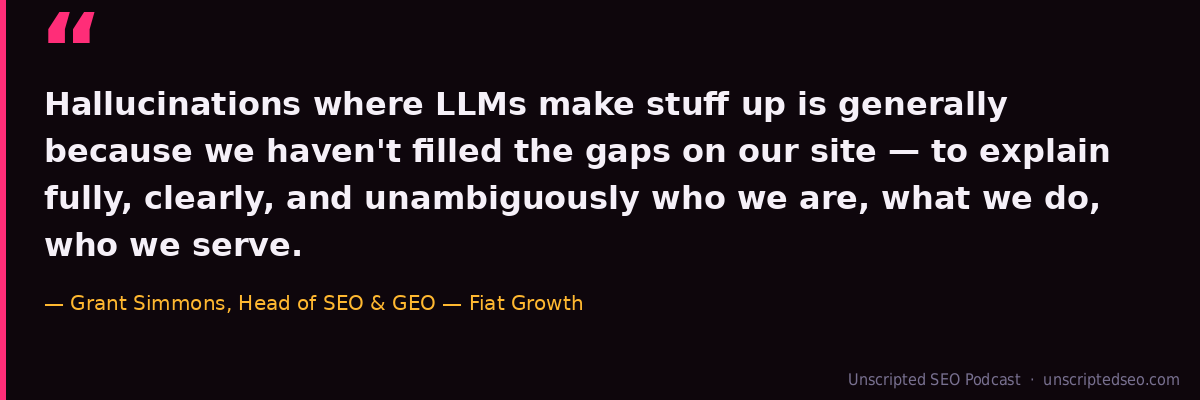
LLMs hallucinate about your brand because they are pattern-matching against everything they were trained on — and if your site hasn't stated clearly, specifically, and repeatedly what you are, what you do, and who you serve, they fill the gaps with something plausible. Sometimes accurate. Often not.
More schema does not fix this. More content does not fix this. Only doing the foundational entity work fixes this.
An Entity Home Is Not a Page. It's a Signal System.
One reason this problem is easy to miss is that from the inside, a brand's presence usually feels fine. Leadership can describe the company in one sentence. The About page exists. The services are listed.
But Simmons draws a sharp distinction between a page that describes an entity and an entity home that functions as one — connected to known graph sources, unambiguous in its disambiguation, tight around a single main entity per page without what he calls query drift.
"When you look at a page, is it tight around distinct entity topics?" he explained. "Is there what I call query drift — outlier topics bleeding in that probably deserve their own page?"
His tool Query Drift was built specifically to answer that question at scale, using Google Search Console data to surface the gap between what a page is actually about and what the surrounding query set suggests machines think it covers. Agencies and brand teams that understand what entity-level page analysis actually measures know this dynamic well — traffic metrics can look acceptable while entity clarity is completely absent.
The EntityMap Standard: A Meaning Layer, Not a Summary
Simmons pointed to a newly launched standard — EntityMap.org, developed through Waikay by Dixon Jones and Fred Loral — as the formalization of what entity SEO practitioners have been doing manually for years.
The concept is simple but easy to misread. An EntityMap is not a summary of what a page says. It is a structured map of what a page means — its associations, its disambiguations, its connections to known graph sources. The distinction matters enormously for how LLMs interpret and represent your brand.
"It's a meaning layer," Simmons said. "Not just saying, this is what the page is about. It's the connections."
Applied to a brand's key pages, this means going beyond on-page optimization and into explicit relationship-building between your entity and the known, well-defined concepts in the web's graph. Wikipedia citations. Schema sameAs references.
Authoritative catalogs
. The same signals that help Google understand an entity are the grounding signals that help LLMs represent one accurately. Practitioners running LLM visibility tracking are increasingly finding that brands that have done this work are more consistently represented — and those that haven't are the ones getting hallucinated.
What About Brands That Seem Ungoogleable?
Jeremy raised a practical challenge during the conversation: what happens with highly technical or niche brands — the kind where even the category name is opaque? Sometimes it's obvious, like selling coins online, but not every company is selling something people can picture.
Simmons reframes the premise.
"For the person who needs the product, the entity clarity problem is never abstract. LLMs need to know who you serve, where you serve them, and what distinguishes you. If you haven't stated that clearly and connected it to the known graph, you don't exist as a distinct entity — you exist as noise."
The product looks unrepresentable to machines only when the site stays at the surface level — describing features without connecting them to known concepts, naming categories without linking to authoritative definitions, listing services without establishing the entity relationships that help a grounding index classify them.
"Even highly technical or niche companies can become unambiguous when they do the foundational entity work," Simmons said. "The same is true for AI visibility. The category is rarely the obstacle. The clarity is."
Visibility Without Clarity Is a Magnifier, Not a Solution
Jeremy made a related observation during the conversation: businesses that publish consistently but without entity clarity are essentially scaling their ambiguity. More content, more confused signals. The AI doesn't know which entity to attribute it to.
Simmons agreed — and extended the point to schema.
"Google AI Overviews are still the most prominent AI surface," he said. "If you're not using schema for ontology categorization at a mid-surface level — not deep-nesting every concept on every page, but doing the foundational work — you're leaving the categorization signals to chance."
The practical upshot: RAG in LLMs is largely a wrapper for Google results. What helps Google categorize your content correctly flows through to the LLM layer. Schema isn't about rich results in isolation. It's about the grounding index understanding what you are — and that understanding propagating into AI Overviews, and from there into LLM responses. Reporting that accurately connects SEO effort to AI visibility outcomes is increasingly the benchmark for agency value — activity metrics can look strong while AI representation is completely absent.
LLMs Can Polish Your Entity Signals — They Cannot Produce Clarity
The conversation also touched on LLM tools in the SEO workflow, and Simmons' take is worth noting for anyone building GEO processes around AI assistance.
"I don't outsource uncertainty to LLMs," he said. "I don't take what they say as the answer I want. I take it as the answer they give me."
Useful for drafting, organizing, refining. Not useful for the foundational question: have you actually told machines who you are, unambiguously and in the form they can parse? The same test applies once a business moves past content and starts putting AI to work inside its operations. An agent that answers inbound calls, qualifies leads, or drafts proposals still has to know exactly what the business is, what it sells, and who it serves — the same entity questions Simmons asks of a website. That is why good agentic AI consulting in Nashville starts by scoping one or two narrow jobs an agent can own, rather than bolting a chatbot onto a brand that hasn't defined itself yet. Clarity comes first. Automation only scales whatever is already there.
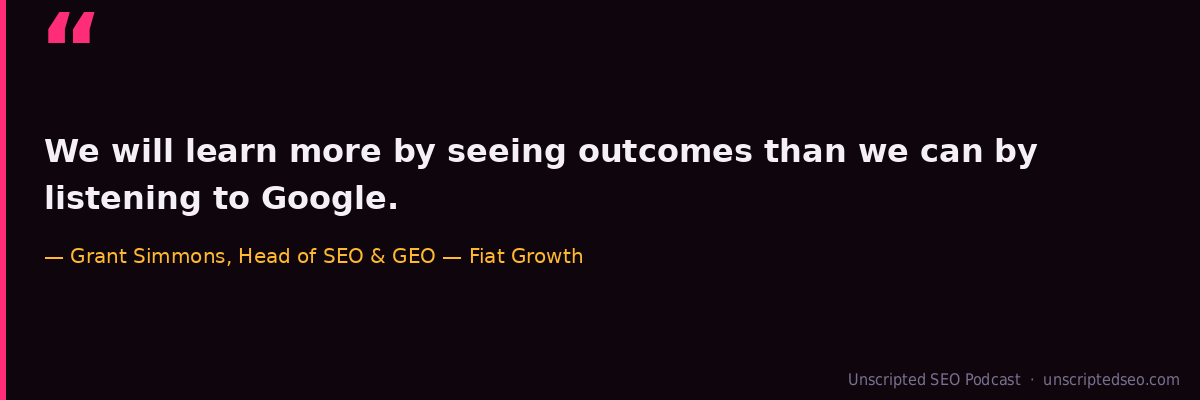
"We are just in a big petri dish right now," Simmons said. "People are dropping little droplets and going, does this work? And we can see after a few days whether culture has grown or not."
Without the entity clarity foundation, AI-produced content is grammatically correct noise organized around an outline — feeding the confusion rather than resolving it. The same output every other brand's AI is producing, delivered faster, and attributed to no one in particular.
The Diagnostic Questions That Matter
If your brand keeps getting hallucinated, misrepresented, or invisible in AI-generated answers, Simmons' argument is that the next step is not more schema or more content. The best next step is to examine whether your entity foundation is doing the work it needs to do.
Three questions worth sitting with:
- Can a machine state simply and unambiguously what your brand is, what it does, and who it serves?
- Is each key page on your site tight around a single entity — or does it have query drift pulling it toward multiple competing concepts?
- Are your pages connected to the known graph through schema, Wikipedia references, and authoritative catalogs — or are they describing things without anchoring them to known concepts?
Until those questions are answered, most GEO efforts will struggle to gain traction. Once they are, even modest entity work begins to compound — because every new signal lands on a foundation machines can actually classify.
Where This Leaves SEO Practitioners and Brand Teams
The issue is not a lack of effort. Most brands are publishing, optimizing, and auditing regularly. But as Simmons put it, if the entity foundation is unsettled, even well-conceived GEO initiatives tend to underperform — because they are building on something that has not yet been fully formed.
"The fundamentals haven't changed," he said. "Fill the gaps on your site. Explain who you are. Create an entity home and reinforce it."
You can read Grant's original deep-dive on the conversation at the Waikay blog, and explore his tools — Query Drift for entity-level page analysis and AppSlicer for AI Overview impact estimation — if entity clarity is something your brand is actively working through. Find him at Fiat Growth or on LinkedIn.