Why Your Marketing Isn't Persuading Anyone (And It's Not a Tactics Problem)
Most small businesses and nonprofits that struggle with marketing have already tried the obvious fixes. They redesigned the website. They ramped up social media. They ran ad campaigns and, in some cases, undertook a full rebrand.
When none of it moves the needle, the natural conclusion is that the tactics need to improve. In most cases, that conclusion is wrong.
That is the core argument Bruce Ashford made when he sat down with Jeremy Rivera on Unscripted Small Business. Ashford, founder of The Ashford Agency and a certified StoryBrand guide, works with CEOs of small businesses and nonprofits who are working hard and still not growing. His diagnosis is almost always the same: the problem is not effort, budget, or channel selection. It is message clarity.
The Real Problem Is Almost Never Tactical
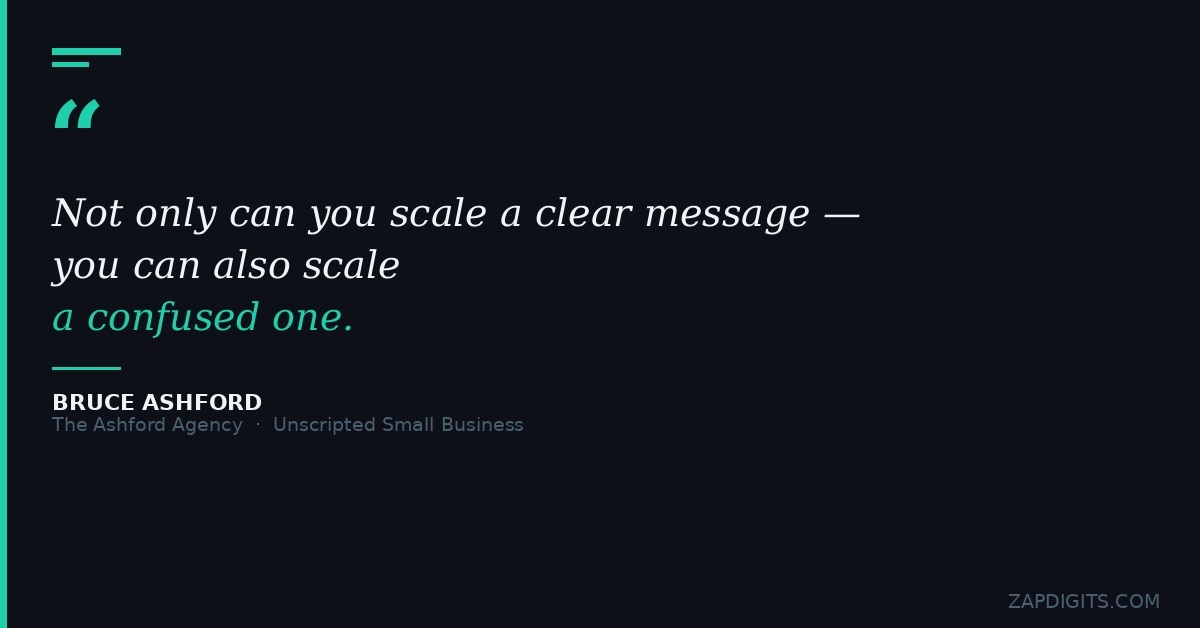
"Most marketing problems aren't tactical problems," Ashford said. "They are message clarity problems."
The organization, in his experience, has not yet done the work of stating simply and compellingly what it does, who it serves, and why it matters. And because that foundational work has not been completed, everything built on top of it begins to wobble.
More activity does not fix the problem. It intensifies it.
"Not only can you scale a clear message," Ashford explained, "you can also scale a confused one."
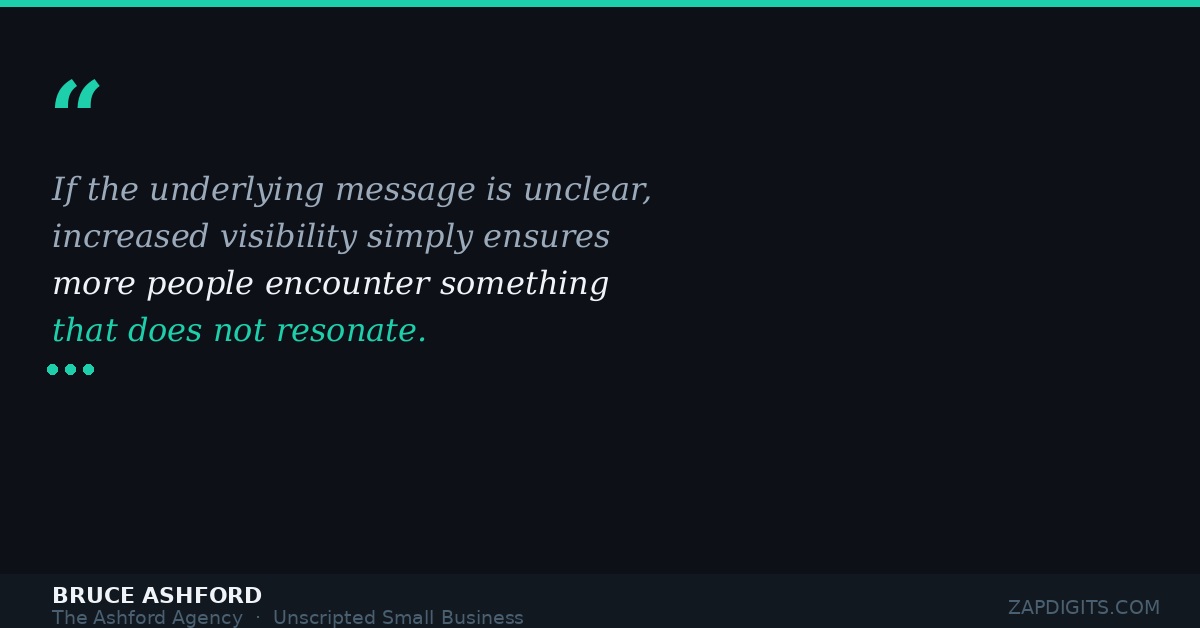
This is the uncomfortable math behind most underperforming marketing budgets. When the message itself is the issue, increasing spend, output, and channel coverage simply ensures that more people encounter something that does not resonate. This is something business planners like Jonathan Davies address, ensuring that your busienss fundamentals align with your messaging, and connects with real data. Agencies and business owners who understand what client reporting actually measures know this dynamic well — activity metrics can look strong while persuasion is completely absent.
Internal Agreement Is Not the Same as External Clarity
One reason this problem is so easy to miss is that from the inside, a business's message usually feels fine. Leadership understands what the organization does. The staff understands it. The language has been discussed, revised, and approved.
But as Ashford put it: "Internal agreement is not the same thing as external clarity."
What he typically finds when he begins working with a client is messaging that may be technically accurate, or partially clear, but fundamentally incomplete.
"It may describe what the organization does, but it does not yet communicate in a way that helps the audience understand why it matters or what to do next. As a result, it doesn't carry weight. It doesn't stay with people or move them to act."
The Story Structure Every Persuasive Message Follows
Ashford's approach to fixing this draws on a pattern older than any marketing framework — one borrowed from Hollywood films and bestselling fiction.
Every compelling story follows the same arc: a central character wants something, that desire is complicated by a problem, the character cannot solve the problem alone, a guide appears and offers a way forward, and when the character acts on the guide's advice, they solve the problem and experience the results.
Applied to business, the implication is direct: the customer is the hero. You are the guide.
"That may sound obvious," Ashford acknowledged, "but it is routinely violated."
Many businesses position themselves as the hero of the story — their history, their capabilities, their products. The customer becomes secondary. Many organizations also never foreground the problem the customer actually experiences and how it makes them feel.
"When a business or nonprofit message neglects these basic components, the message loses its force."
For a deeper look at how these six components interconnect inside an organization, Ashford's post on why growth problems are structural is worth reading alongside this conversation. He referenced
What About Products That Seem Boring?
Jeremy raised a practical challenge during the conversation: what happens when the product itself is not inherently interesting? He gave a concrete example — a recent client selling battery energy storage system walls. How do you build a compelling message around something that technical, that niche?
Ashford's answer reframes the premise.
"For the person who needs the product, the problem it solves is rarely boring. It may be frustrating, time-consuming, or costly. It may interfere with their work or their responsibilities. It may create a persistent sense that something is not functioning as it should."
The product looks uninteresting only when messaging stays at the surface level — describing features or categories rather than the lived experience of the problem. When you articulate the internal dimension of the problem, the experience changes.
"Even highly technical or niche companies — whether in construction, manufacturing, or agriculture — can become compelling when they learn to describe the problem in human terms."
The same principle applies to any business that has convinced itself its category is too dry to market well. The category is rarely the obstacle. The message is. Ashford explores this further in his piece on how "intelligent" messaging quietly erodes ROI — where the pursuit of sophistication actively works against persuasion.
Visibility Without Clarity Is a Magnifier, Not a Solution
Jeremy made a related observation during the conversation: businesses that are active in their communities but fail to document or share that activity effectively disappear from the digital landscape. If you're an atlanta law firm, and doing local free legal consulting then ensure that effort is reflected online too! If you fail that step, that is a real and costly gap in local SEO and content strategy.
Ashford agreed — but with an important caveat.
"Visibility alone does not produce persuasion."
If the underlying message is unclear, increased visibility simply ensures that more people encounter something that does not resonate. In that sense, more traffic, more mentions, and more reach can actually magnify the problem they were meant to solve.
AI Can Polish Bad Writing — It Cannot Produce Clarity
The conversation also touched on AI in marketing, and Ashford's take is worth noting for anyone building content workflows around AI tools.
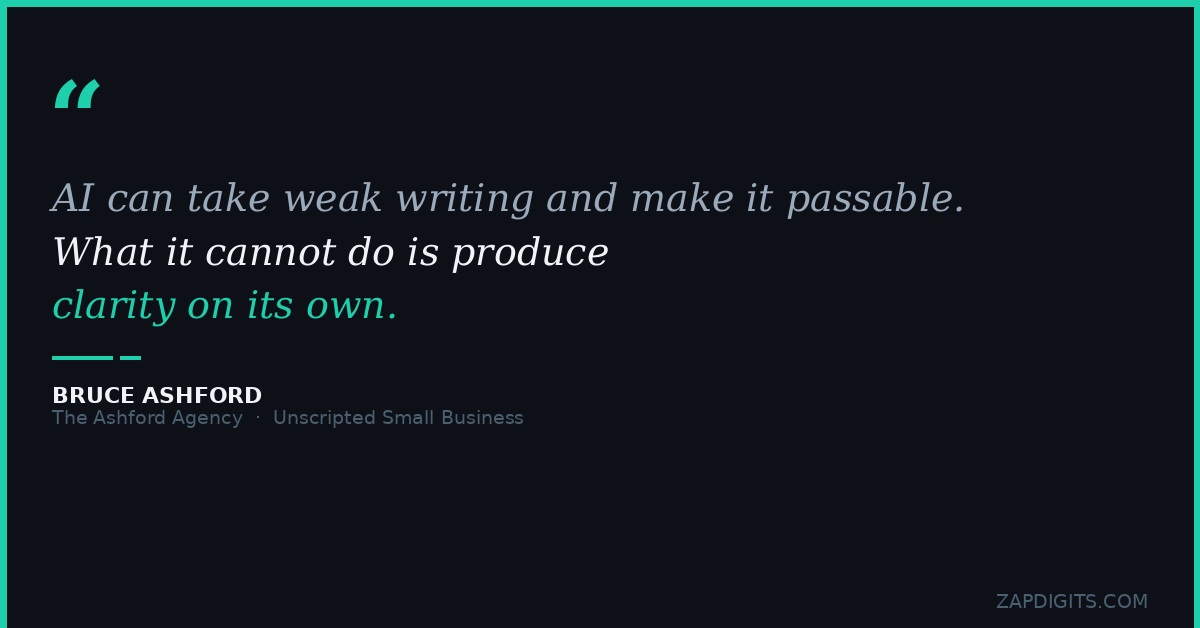
"AI is incredibly useful, when leveraged in the right way and with careful human oversight. It can assist in drafting, organizing, and refining content. It can take weak writing and make it passable."
But clarity is a different problem entirely.
"Clarity is the result of disciplined thinking. It requires decisions about what to emphasize, what to exclude, and how to frame the problem in a way that aligns with the audience's experience."
Without that foundation, AI produces what Ashford described as grammatically correct sentences organized logically around an outline — eminently forgettable and unlikely to move a person to action. The same output everyone else's AI is producing, delivered faster. Definitely a consideration for any AI agents for small businesses in Nashville or any other major city. How do you deliver real value as an SMB instead of just being memory holed after a few minutes.
The Diagnostic Questions That Matter
If your marketing is underperforming, Ashford's argument is that the next step is not to refine tactics or increase output. The best next step is to examine whether the message is doing the work it needs to do.
He offers three questions worth sitting with:
- Can the message be stated simply?
- Does it reflect the customer's point of view?
- Does it make a claim that is both clear and meaningful?
Until those questions are answered, most marketing efforts will struggle to gain traction. Once they are answered, even modest efforts begin to compound.
For organizations ready to take that examination seriously, Ashford's piece on why you can't fix what you refuse to examine walks through what a rigorous organizational inventory actually looks like — and why informal strategy conversations rarely get there.
Where This Leaves Small Business Owners
The issue is not a lack of effort. Organizations are often working hard and thinking strategically. You have to work that into your very business plan, and as Deacon Wealth Management addressed in a recent post is making sure your marketing message is sufficiently clear and complete to bear the weight of that effort and strategy.
"When that foundation is unsettled, even well-conceived initiatives tend to underperform because they are carrying something that has not yet been fully formed. Over time, this leads to a pattern of activity without results."
The creation of a clear and complete message changes that dynamic. It gives marketing strategy and budget something solid to rest upon. And once that is in place, the work that follows is more likely to accumulate rather than dissipate.
You can read Bruce Ashford's original write-up of this conversation on The Ashford Agency blog, and explore his full services for small businesses and nonprofits if message clarity is something your organization is actively working through.