
Google used to be the place people went to discover new products, compare services and find answers.
Now, more people are asking ChatGPT, Perplexity, Gemini and other AI tools to do that research for them.
Instead of searching for "best email marketing software" and opening ten websites, someone might simply ask ChatGPT:
What's the best email marketing software for a small marketing agency?
The AI gives them an answer, recommends a few products and sometimes explains why those products are worth considering.
If your brand isn't mentioned, you might be missing an opportunity to reach that potential customer.
This is where Generative Engine Optimization (GEO) comes in.
GEO is the practice of improving your brand's visibility across AI-powered search and answer engines. The goal is to make your business easier to discover, understand, reference and recommend.
But here's the thing: there isn't one magic trick that gets ChatGPT to recommend your business.
You need to build a strong online presence, publish useful content, earn mentions from relevant websites and communities, and understand how people discover your brand.
I've put together this playbook to help you do exactly that.
Whether you're running a SaaS company, marketing agency, e-commerce store or another online business, these are the strategies I'd focus on going into 2027.
Let's get started.
1. Find GEO opportunities using Google Search Console
Before spending money on AI visibility tools or creating dozens of new articles, start with something you probably already have: Google Search Console.
Your Search Console data contains a lot of useful information about what people are searching for to discover your website.
More importantly, it can help you find specific questions and long-tail search queries that you can turn into content opportunities.
Find long-tail search queries using a custom regex
Here's a simple trick.
- Open Google Search Console.
- Go to Performance → Search results.
- Click + New → Query.
- Select Custom (regex).
- Paste the following expression:
^(?:\S+\s+){7,}\S+$
This filters search queries containing eight or more words.
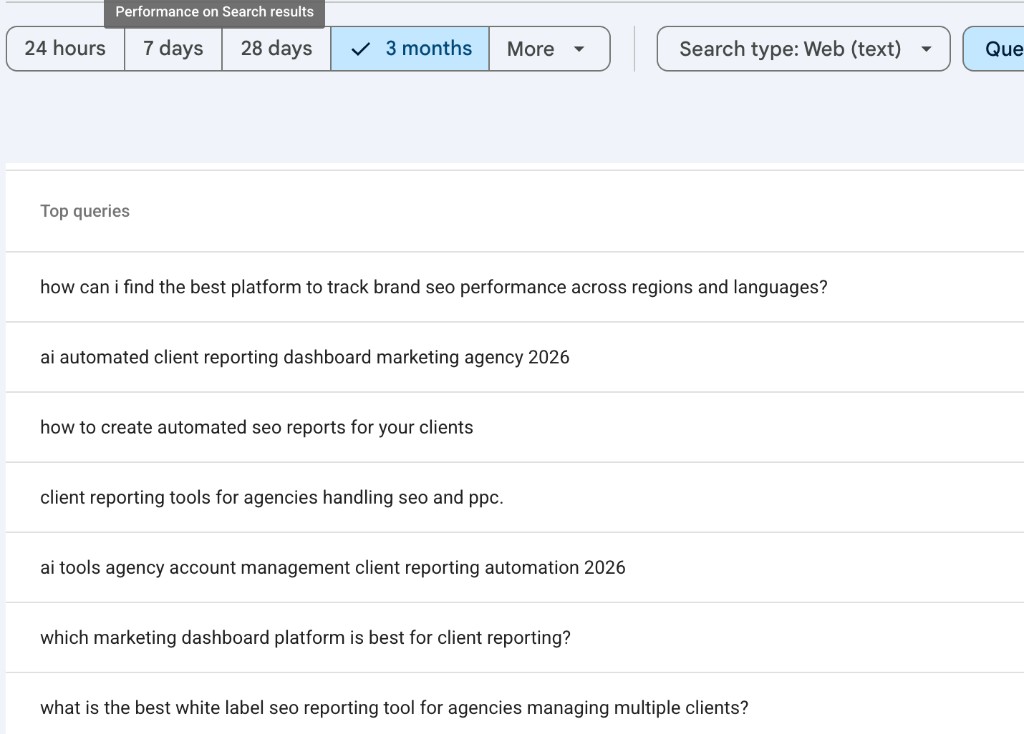
Why eight or more words?
Because longer queries often reveal more specific search intent. They can tell you what people are trying to solve, what products they're comparing and what questions they have before making a purchase.
For example:
- Best reporting tools for small marketing agencies
- How to track website traffic from AI search engines
- Which SEO reporting software supports white label dashboards?
- How can I improve my brand visibility in ChatGPT?
- What is the best alternative to [competitor] for small businesses?
These are useful content opportunities.
What should you do with these queries?
Once you have your list, start looking for patterns.
1. Find questions you haven't answered.
If people are searching for something related to your product but you don't have a useful page answering it, that's an opportunity.
2. Look for impressions but few clicks.
These queries suggest Google is already showing your website for a particular topic, but your result might not be convincing enough to earn clicks.
Consider improving the page title, description and content.
3. Group similar queries into topics.
Don't create a separate article for every variation of the same question. Group related queries and build one genuinely useful resource.
4. Turn these queries into AI prompts.
Take the questions and search terms you've discovered and use them to build a list of prompts to test in ChatGPT, Perplexity and Gemini.
For example, if people are searching for "best SEO reporting software for small agencies", you can test:
- What are the best SEO reporting tools for small agencies?
- Which SEO reporting tools offer white-label dashboards?
- What are some affordable alternatives to AgencyAnalytics?
Now you have a starting point for understanding whether AI tools recommend your brand for the topics your potential customers care about.
My tip: Don't just chase keywords with high search volume. Look for specific questions that reveal what your potential customers actually want to know.
These are excellent starting points for both your SEO and GEO strategies.
2. Check whether AI tools actually mention your brand
Before trying to improve your AI visibility, you need to understand where you currently stand.
Open ChatGPT, Perplexity and Gemini and start asking questions your potential customers would ask.
Don't just search for your brand name. That's not enough.
You want to understand whether AI tools recommend your business when someone doesn't already know you exist.
For example, imagine you sell project management software.
Try prompts such as:
- What are the best project management tools for small agencies?
- What are some affordable alternatives to Asana?
- Which project management tools are best for remote teams?
- Recommend five project management platforms for a growing marketing agency.
Pay attention to:
- Does your brand appear?
- Which competitors are recommended?
- How does AI describe your product?
- Does it mention your actual features?
- Which websites and sources does it reference?
- Is the information accurate and up to date?
Build a prompt list
I recommend starting with 20 to 30 prompts.
Divide them into three groups:
Discovery prompts — people looking for solutions without knowing which product to choose.
Comparison prompts — people comparing products, alternatives and competitors.
Problem-based prompts — people describing a problem and asking AI to recommend a solution.
Save the answers and repeat the same tests regularly.
One important thing: AI answers can vary between runs, models, locations and dates. Don't make decisions based on one response. Look for patterns across multiple prompts and repeated checks.
This gives you a baseline to compare against as you implement the strategies in this playbook.
3. Get your brand mentioned on Reddit
If there's one platform I'd pay particular attention to when working on GEO, it's Reddit.
Reddit is full of real discussions where people share experiences, ask questions, compare products and recommend solutions.
These conversations can also become sources for AI-generated answers.
However, don't assume that simply publishing a Reddit post guarantees an AI mention. Different platforms retrieve and cite different sources, and there are no guaranteed shortcuts.
The opportunity is to become part of the conversations your potential customers are already having.
Find relevant subreddits
Start by identifying communities related to your industry.
For example:
- r/SaaS
- r/Entrepreneur
- r/marketing
- r/SEO
- r/smallbusiness
These are just starting points. Find smaller communities where your actual target audience spends time.
Find existing discussions
Search Reddit for questions related to your product.
Some useful searches include:
- Best [product category] tools?
- Alternatives to [competitor]
- How do you solve [specific problem]?
- What tools do you use for [specific task]?
- Recommendations for [your target audience]?
Look for discussions that already have engagement.
These conversations tell you what people care about, what problems they experience and which products they already trust.
Participate in conversations
This is where many companies get it wrong.
They create an account, publish a promotional post and expect people to recommend their product.
That usually doesn't work.
Instead:
- Answer questions with genuinely useful information.
- Share your experience solving a particular problem.
- Explain the advantages and disadvantages of different approaches.
- Recommend tools when they're genuinely relevant.
- Be transparent when you're affiliated with a product.
- Don't use fake accounts to manufacture recommendations.
You can also create your own discussions.
For example, instead of posting "Check out our new SEO tool", start a conversation about a problem your audience experiences.
Ask people how they currently solve it. Share what you've learned. Contribute something useful.
Turn customer experiences into discussions
If you have happy customers, encourage them to share their honest experiences.
A genuine customer explaining how they use your product is much more valuable than a company publishing another promotional post.
My tip: Think of Reddit as a community where you build trust, not another distribution channel where you dump links.
Consistent participation is more valuable than publishing 20 promotional posts in a week.
4. Build backlinks and increase your website authority
Backlinks are still an important part of a strong SEO strategy.
A backlink is simply a link from another website pointing to yours.
But not all backlinks are equal.
A relevant link from a respected website in your industry can be much more valuable than dozens of links from unrelated websites.
While backlinks aren't a guaranteed way to get mentioned by AI, they help build your website's authority and discoverability.
Understand Domain Rating (DR)
You have probably seen metrics such as:
- Domain Rating (Ahrefs)
- Domain Authority (Moz)
- Authority Score (Semrush)
These are third-party metrics that estimate the strength or authority of a website based on their own methodologies.
They aren't Google ranking factors, and a high DR doesn't automatically mean an AI platform will recommend your brand.
Still, they can be useful when evaluating potential websites for outreach and link building.
My recommendation is to focus on three things:
- Relevance to your industry.
- Quality and credibility of the website.
- Whether the link can bring actual referral traffic or potential customers.
Don't spend your entire SEO budget chasing a DR of 70.
A relevant industry website with a DR of 30 might be a much better opportunity.
Find websites that already mention your competitors
This is one of my favourite backlink research strategies.
Use Ahrefs or Semrush to investigate your competitors' backlinks.
Look for:
- Industry blogs.
- Software comparison websites.
- Product directories.
- Guest articles.
- Industry publications.
- Resource pages.
- Partner websites.
If a website has already mentioned your competitor, there's a reasonable chance it might be interested in covering your product too.
Other ways to earn backlinks
Here are some practical approaches:
Guest posting: Contribute useful articles to websites in your industry.
Industry directories: Get your business listed on relevant directories.
Digital PR: Publish original research, surveys or interesting industry data that journalists and bloggers might reference.
Case studies: Work with customers and partners to publish real results.
Free resources: Create templates, calculators, checklists and tools that other websites might want to reference.
Competitor link analysis: Find websites linking to competing products and identify opportunities to earn your own mention.
Remember, the goal isn't simply to collect links. It's to make your brand more visible across relevant parts of the internet.
5. Create content that AI engines can understand and reference
Publishing content is one of the most important parts of a long-term GEO strategy.
But there's a problem.
A lot of websites are publishing the same articles, answering the same questions and repeating the same advice.
If your article doesn't add anything new, why would someone choose to reference it?
Focus on creating content that provides something genuinely useful.
Write content around real questions
Use your Google Search Console research, Reddit discussions, customer support conversations and sales calls to identify questions people actually ask.
Then create content that answers those questions.
Some examples:
- How to choose the right [product category].
- [Product A] vs [Product B]: Which is better?
- Best alternatives to [competitor].
- How to solve [specific industry problem].
- A complete guide to [specific topic].
Don't just write articles because a keyword has search volume.
Think about what the reader wants to accomplish.
Publish original research
This is an opportunity many businesses overlook.
Instead of publishing another article summarizing existing information, collect your own data.
For example:
- Survey 100 marketing agencies about their reporting processes.
- Analyze pricing across 50 competitors.
- Publish industry benchmarks.
- Share insights from your own product usage data.
- Run experiments and publish the results.
Original research gives other websites something new to reference.
It can also generate backlinks, social discussions and brand mentions.
Include real experiences and examples
If you've solved a problem for a customer, explain how you did it.
Include:
- The original problem.
- What you tried.
- What worked.
- What didn't work.
- The final results.
First-hand experience makes content more useful and gives readers something they cannot get from another generic article.
Make your content easy to navigate
Some practical recommendations:
- Use descriptive headings.
- Answer the main question early.
- Include examples and supporting data.
- Use tables for comparisons.
- Add relevant images and diagrams.
- Link to useful supporting resources.
- Include author information and credible references.
- Keep outdated information updated.
You don't need to write specifically for AI. Write for people, make the information clear and provide enough context for search engines and AI systems to understand it.
6. Optimize your website for AI discovery
Your website is still one of the most important sources of information about your business.
If AI tools cannot access your website or understand what your product does, you're making discovery harder than it needs to be.
Start with the technical basics.
Make sure search engines can crawl your website
Check that:
- Your important pages are accessible.
- Your website isn't accidentally blocking search crawlers.
- Your robots.txt file is configured correctly.
- Your XML sitemap is available.
- Important pages are internally linked.
- Your content is available in readable text.
- Your pages are indexed where appropriate.
Also review crawler access for the AI platforms you want to support. Different platforms have different crawlers and access policies.
Use structured data where appropriate
Structured data helps search engines understand information about your website.
Depending on your business, consider:
- Organization schema.
- Product schema.
- Article schema.
- Breadcrumb schema.
- LocalBusiness schema.
Make sure your structured data accurately reflects the information users can see on your website.
Don't add irrelevant schema just because someone told you it improves GEO.
Make your brand information consistent
Check how your company is described across:
- Your website.
- LinkedIn.
- Product directories.
- Review websites.
- Social profiles.
- Industry publications.
Your product name, description, pricing and main features should be consistent.
If your website says one thing and your other profiles say something completely different, you're creating unnecessary confusion.
What about llms.txt?
You might have seen recommendations to create an llms.txt file for your website.
It's a proposed format intended to provide AI systems with useful information about your website.
You can experiment with it if you want, but don't treat it as a requirement for GEO.
Google's official guidance says that special AI files such as llms.txt aren't required for visibility in Google AI features.
Focus on crawlability, useful content and a technically sound website first.
7. Build your brand's presence across the internet
Here's something worth remembering:
Your website isn't the only place where people can learn about your business.
AI tools can retrieve information from many different sources across the internet.
That's why building your brand's presence outside your own website matters.
Get listed on relevant platforms
Depending on your industry, consider:
- G2.
- Capterra.
- Trustpilot.
- Product Hunt.
- AlternativeTo.
- Industry-specific directories.
- Professional associations.
Don't submit your company to every directory you can find.
Choose platforms that your potential customers actually use.
Encourage genuine customer reviews
Reviews help potential customers understand what it's like to use your product.
Ask happy customers to share their honest experiences.
Don't buy fake reviews or offer incentives in exchange for positive ratings.
Build relationships with other brands
Find companies, creators and publications that serve the same audience.
Look for opportunities to:
- Collaborate on content.
- Publish joint research.
- Appear in podcasts.
- Participate in webinars.
- Contribute to industry discussions.
- Create useful comparison resources.
Don't ignore social platforms
Maintain a useful presence on LinkedIn, YouTube and other platforms relevant to your audience.
Share your experience, publish educational content and participate in discussions.
The goal is to create more credible places where people can discover and learn about your brand.
8. Use AI visibility tools to make everything easier
You can manually check ChatGPT, Perplexity and Gemini, but doing this for dozens of prompts across multiple platforms quickly becomes time-consuming.
This is where AI visibility tracking tools become useful.
They help you monitor how your brand appears in AI-generated answers, compare your visibility against competitors and understand which prompts and topics are driving mentions.
Here are some tools worth exploring.
1. ZapDigits.ai
ZapDigits.ai is a tool I built to help businesses understand how they appear in AI search.
Instead of manually checking different AI platforms, you can use it to monitor brand visibility and understand how your business is performing across relevant search prompts.
One of the things I wanted to focus on is going beyond simply showing whether your brand was mentioned.
Understanding the actual clicks and impressions associated with search prompts is also important. It helps connect visibility research with real search behaviour.
If you're starting with GEO, having a way to monitor your progress and identify opportunities makes the whole process easier.
Website: https://zapdigits.ai
2. Profound
Profound is an AI visibility platform focused on helping brands understand how they appear across AI search experiences.
It's worth exploring if you want more advanced brand visibility research and competitive insights.
3. Peec AI
Peec AI helps businesses monitor brand visibility across AI platforms and understand how their competitors appear.
It's another option for teams that want to track AI search performance over time.
4. Otterly.AI
Otterly.AI focuses on AI search monitoring, including brand mentions and citations across AI-powered search experiences.
It's worth checking out if you want a dedicated monitoring tool.
5. Ahrefs and Semrush
These are still useful tools for traditional SEO research.
You can use them to:
- Research keywords.
- Analyze backlinks.
- Discover competitor content.
- Find link-building opportunities.
- Monitor organic search performance.
GEO doesn't mean abandoning SEO.
Your traditional SEO tools are still valuable parts of the process.
6. Google Search Console
And of course, don't forget the free tools you already have.
Google Search Console helps you understand how people discover your website through Google Search.
Use it to find long-tail queries, identify content opportunities and monitor organic search performance.
My recommendation: You don't need six different subscriptions to start with GEO. Begin with Google Search Console, a tool for AI visibility tracking and an SEO research tool. Add more when you have a clear reason.
9. Measure your GEO performance
One of the biggest mistakes companies make is implementing GEO strategies without measuring whether anything is improving.
You need to know whether your efforts are actually making your brand more visible.
Here are the metrics I'd pay attention to.
Brand mention frequency
How often does your brand appear in AI-generated answers for your tracked prompts?
Track this across multiple AI platforms.
AI share of voice
How frequently does your brand appear compared with competitors?
For example, if you track 100 relevant prompts and your brand appears in 20 of them, you can use that as a starting point for your visibility measurement.
Compare the same prompts against your competitors.
Citation frequency
How often do AI platforms reference your website or other sources mentioning your brand?
Pay attention to which URLs are being cited.
Competitor visibility
Which competitors are consistently recommended instead of you?
Look at their content, backlinks, reviews and external mentions to identify potential opportunities.
AI referral traffic
Use Google Analytics 4 or your analytics platform to understand how much traffic comes from AI platforms.
Look at:
- Sessions.
- Engaged sessions.
- Landing pages.
- Conversions.
- Revenue where applicable.
Conversions
This is ultimately what matters to most businesses.
Getting mentioned by ChatGPT is nice, but if those mentions never result in visitors, leads or customers, you need to understand why.
Don't confuse visibility with business results.
Track both.
10. Your 90-day GEO action plan
If you're starting from scratch, don't try to implement everything at once.
Here's a simple 90-day plan I'd follow.
Month 1: Research and foundations
Week 1
- Set up Google Search Console.
- Find long-tail queries using the regex filter.
- Research your competitors.
- Build a list of 20 to 30 AI prompts.
Week 2
- Test your brand visibility across ChatGPT, Perplexity and Gemini.
- Record competitor mentions.
- Identify which sources AI tools reference.
- Set up an AI visibility tracking tool.
Week 3
- Audit your website's technical SEO.
- Check indexing and crawler access.
- Review your important landing pages.
- Fix inconsistent brand information.
Week 4
- Identify content gaps.
- Find relevant subreddits.
- Research competitor backlinks.
- Build your content and outreach plan.
Month 2: Build authority and publish content
Week 5
- Publish a detailed comparison article.
- Improve an existing high-potential article.
- Create content around questions found in Search Console.
Week 6
- Start participating in relevant Reddit discussions.
- Answer questions in your industry.
- Share useful experiences.
Week 7
- Reach out to relevant industry websites.
- Submit your business to relevant directories.
- Look for guest posting opportunities.
Week 8
- Publish original research, a case study or a useful resource.
- Share it across relevant communities.
- Continue building relationships.
Month 3: Measure and improve
Week 9
- Review your AI visibility.
- Compare results against your initial baseline.
- Identify prompts where competitors consistently appear.
Week 10
- Update content that isn't performing.
- Improve pages with relevant search impressions but low clicks.
- Find missing information on your important landing pages.
Week 11
- Continue Reddit participation.
- Follow up on backlink opportunities.
- Encourage genuine customer reviews.
Week 12
- Review your AI mentions and citations.
- Analyze referral traffic and conversions.
- Identify which activities produced the best results.
- Build your next 90-day plan.
The important thing is consistency.
GEO isn't a one-time SEO task. It's an ongoing process of improving your content, authority and online presence.
11. GEO mistakes you should avoid
Before wrapping up, here are a few things I'd avoid when implementing your GEO strategy.
1. Spamming Reddit
Publishing promotional posts everywhere isn't a strategy. Participate in communities and provide actual value.
2. Buying hundreds of backlinks
Irrelevant links won't magically make your brand authoritative. Focus on relevance and quality.
3. Chasing Domain Rating
DR is a third-party metric, not a measure of how likely AI tools are to recommend your product.
4. Publishing hundreds of AI-generated articles
More content doesn't automatically mean more visibility. Focus on original information and useful experiences.
5. Assuming Google rankings guarantee AI mentions
Good SEO can support discoverability, but AI recommendations are not simply a copy of Google's search results.
6. Optimizing exclusively for ChatGPT
People use different AI platforms. Don't build your entire strategy around one provider.
7. Obsessing over GEO hacks
There is no secret schema, special prompt or magic file that guarantees AI recommendations.
8. Measuring success with one screenshot
AI responses change. Track multiple prompts, platforms and dates before drawing conclusions.
9. Expecting results overnight
Building authority, earning mentions and creating useful content takes time. Give your strategy enough time to produce meaningful data.
Final thoughts: GEO is about building a brand worth mentioning
The biggest mistake I see businesses making is treating GEO as a completely separate discipline from SEO.
It's not.
You still need useful content, a technically sound website, relevant backlinks, genuine customer experiences and a recognizable brand.
What's changing is how people discover and evaluate businesses.
Instead of relying exclusively on traditional search results, people are increasingly asking AI tools to research products, compare alternatives and recommend solutions.
That creates a new opportunity for businesses willing to build their presence beyond their own websites.
Start with the data you already have in Google Search Console. Find the questions people are asking. Participate in relevant communities. Create content worth referencing. Build relationships and earn genuine mentions.
And most importantly, measure whether your brand is actually becoming more visible.
You don't need to do everything at once.
Start with the first few steps in this playbook, stay consistent and improve based on what the data tells you.
The brands that invest in building genuine authority today will be in a much better position when AI becomes an even bigger part of how people discover products and services.